
Society 🫂
An Introduction To Stoicism
0 min read
Stoicism is one of the most misunderstood philosophies of today. Dive in to understand what it really means and where it came from.
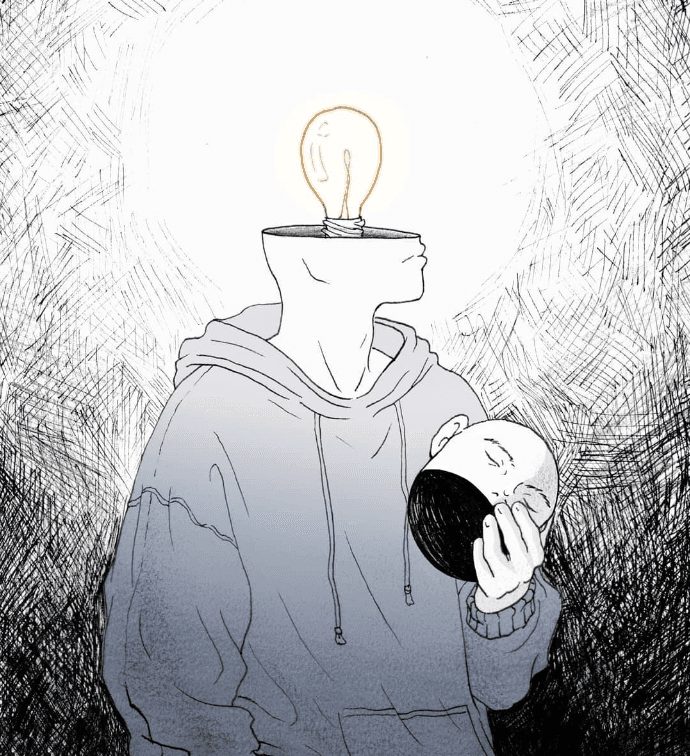
Photo Courtesy: Elliana Esquivel
"Man is troubled not by events, but the meaning he gives them." -- Epictetus.
It is 304 B.C.
A 30-year-old, haggard, dark-skinned merchant is on a voyage from Phoenicia to Peiraeus when his ship is destroyed. Luckily, he survives the shipwreck and lands in Athens, Greece, which at the time was the epicenter of philosophical study.
A bookstore catches his attention as he enters the Polis. He walks in and happens to pick up Memorabilia by Xenophon, a student of Socrates. As he reads about the father of philosophy, a man whose intellect rose above his circumstances, he asks the bookseller excitedly, "Sir, where can I find men like Socrates in this town?" Just then, Crates -- a famous cynic living at the time in Greece -- walks by the bookstore. The bookseller points to Crates, saying, "There's your man! He's the one. Go talk to him."
Soon, he becomes a pupil of Crates, eager to absorb what his teacher has to say.
Cynicism was one of the schools of philosophy back then. The word cynic has nothing to do with the meaning we give it today. Cynicism is a way of living life in virtue and in agreement with nature. It's about rejecting all conventional norms and desires for wealth, power, and fame. It's about living a simple, ascetic life, sometimes in a derisive way in public.
To teach Cynicism, Crates gives the pupil a pot of lentil soup and says, "Here. Now, carry this around wherever you go. That's your lesson number one."
Overcome with bashfulness, the pupil tries to hide the soup under his cloak. But Crates, irked by his lack of respect, smashes the pot, leaving a trail of soup -- dribbling like diarrhea -- down his legs. "You must not feel ashamed of this. You must not care what anybody thinks."
Eventually, though, the pupil leaves Crates to set up his own school of philosophy.
That is what we call today stoicism.
Who invented Stoicism?
The pupil from the story above is Zeno of Citium. His dive into philosophy is supposed to have come from consulting the oracle, a name given to the high priestess of the Temple of Apollo. In his biography, Diogenes, another philosopher, writes that "Zeno's interest in philosophy began when he consulted the oracle to know what he should do to attain the best life, and that the god's response was that he should take on the complexion of the dead. Whereupon, perceiving what this meant, he studied ancient authors." (Interestingly, Socrates' quest for answers is also said to have come from consulting the oracle). Zeno began learning the Cynic philosophy from Crates, but soon discovered that he was too conventional for it. Besides, he realized, there is a way to adopt the same Socratic value system -- of placing knowledge above all desires -- and still live a conventional life where you take part in the policies of your city and be a member of your society. Zeno began teaching his new school of thought at the Stoa Poikile (meaning painted porch) in the Agora of Athens. At first, his disciples were called Zenonians, but soon, they came to be known as Stoics, a name previously given to poets who congregated at the Stoa Poikile.
Athens In 300 B.C.
The world looked very different when Zeno set up a school in 300 B.C. versus when Aristotle did, a hundred years ago. Between 400 and 300 B.C., the greek city-state polis went through many wars and was thoroughly destroyed by the Macedonian Empire. It was a time of utter chaos and confusion. People were feeling far more powerless than their grandfathers and great-grandfathers. So they turned to philosophy as a salve for their soul, slowly separating what they can't control (everything on the outside) from what they can (everything on the inside). More specifically, Stoicism as a philosophy gave them solace in knowing that they were all part of something much greater, thus making the absorption of Polis into the Macedonian Empire more palatable. Alongside Zeno, there were several other schools of philosophy that occupied Greece in 300 B.C.: including the schools set up by Aristotle, Diogenes, Plato, Epicurus. These schools were not diametrically opposite in what they taught. In fact, all of them promised to teach you how to lead a better life and become a better version of yourself.
As Jonathan Rée, philosopher and historian, says, "Choosing between these schools -- which were all proximate to each other -- was more like choosing between Cafe Narrow and Starbucks than choosing between rationalism and empiricism."
The Three Pillars of Stoicism
The philosophy of stoicism really rests on three pillars (or three topois): Logic. Physics. Ethics. As with the word cynic, the meaning of these three words was different back then from what they are perceived to be today. Logic refers to the theory of knowledge, or epistemology, and is more expansive than the modern meaning it's given today. Physics refers to the structure of the physical world, a combination of what we today call metaphysics and natural sciences. Ethics refers to the role we humans play in the physical world around us. Said another way, ethics is the central pillar that guides you on how to live your life in virtue with nature. But to build strong ethics, you need a good understanding of the workings of the world (physics) and the capacity to reason correctly (logic).
Keep Reading...
I plan to continue appending my learnings here over the coming weeks and build a comprehensive guide on Stoicism, so if you'd like to join me on this intellectual journey, sign up for my weekly newsletter to get updated on future articles. :)
All Stories
Mind & Psychology 🧠
Society 🫂

A Brave (Strange) New World Summary
5 min read
A Brave New World, by Aldous Huxley, is one of the great futuristic dystopian novels of the 20th century. But how close was its prediction?
Photo Courtesy: Sako Asko
I first came across A Brave New World in another book, called Amusing Ourselves To Death (quite a title indeed). In Amusing Ourselves to Death, Neil Post argues that although two great dystopian novels were published in the 19th century predicting the future of humanity, only one of them got it right.
And it wasn't the novel that most people thought would get it right.
It wasn't 1984 by George Orwell, no. It was indeed A Brave New World by Aldous Huxley.
A Strange New World
Picture 2540 C.E., or as it's written in A Brave New World, 632 A.F. where A.F. refers to After Ford. The world of 632 A.F. is not a brave one; rather a strange one. With the "headquarters" set in London, the novel begins with Mustapha Mond, one of the "Ten World Controllers" (or the current equivalent of an oligarch dictator), taking a bunch of school children on a tour around the Central London Hatchery and Conditioning Center where children are created outside the womb and cloned relentlessly in order to increase the population and efficiency.
Children are sorted into one of the five classes from the moment they're an embryo: Alphas, Betas, Gammas, Deltas, and Epsilons. Those in the upper classes enjoy the greater privilege.
Further, since children are created outside the womb, they are thoroughly conditioned. To do what, you might ask? All sorts of things. To hate books and flowers, to love Soma (a drug that makes people happy), to never think about history, to revere technoloy, to be with as many partners as they'd like, and to value society over any form of individuality. In such a world, you're never alone. You're surrounded by people. You take soma everyday. You sleep with anyone you want. And solitude is a laughable idea.
Similarities, and Differences
Huxley wrote this novel in 1932, between WWI and WWII. A time when technology was proclaimed to be the solution to war and disease; and the idea of efficiency and mass production was championed thanks to Henry Ford.
While reading this book, I couldn't help but notice many similarities (and differences) between world painted by Huxley and the world we live in today. Here are my observations:
Similarities
Their hypnopaedic messages = our advertisements: I opened YouTube today to watch the ad "Yes to Prop 27" for the 10th time this week (and this week just started). In A Brave New World, the "conditioning" happens when the children grow up in a high-tech decantation center. Messages get whispered in their ear on loop while they sleep. The messages might say, "Alphas work much harder than we do. They're so much cleverer. I'm so glad I'm a Beta so I don't need to work so hard." Or they could say, "A gramme (of Soma) in time saves nine." The world we live in now does that to us while we're wide awake. We're repeatedly and obsessively exposed to messages: ranging from why we need to vote for Prop 27 to how Mint mobile is the best for you to why pillow-cube is better than a regular pillow. And who can forget the damn GEICO gecko? Their soma = our one-click access to entertainment: In Huxley's world, all someone needed to do to forget their worries and become happy was pop in a gramme of soma. In our world, while drugs are still illegal in many parts of the world (although the situation is changing), we've found other ways to keep ourselves entertained. Or said differently, we've found other ways to escape our worries. As I write this, I'll confess that I'm no more immune to this than you my friend. I've had days when I chose to binge-watch The Office instead of sitting with my feelings. This is scary, mainly because there's no going back from this degree of convenience. Their hate for solitude = our fear of solitude: There's a specific moment in Huxley's book when Bernard Marx, a troubled young man, is out on a date with Lenina Wallace, the quintessential byproduct of thorough conditioning. They're hovering over a sea in their helicopter when Bernard stops the engine to look at the sea. “I want to look at the sea in peace,” he said. “One can’t even look with that beastly noise going on.” “But it’s lovely. And I don’t want to look.” “But I do,” he insisted. “It makes me feel as though…” he hesitated, searching for words with which to express himself, “as though I were more me, if you see what I mean. More on my own, not so completely a part of something else. Not just a cell in the social body. Doesn’t it make you feel like that, Lenina?” But Lenina was crying. “It’s horrible, it’s horrible,” she kept repeating. “And how can you talk like that about not wanting to be a part of the social body? After all, everyone works for everyone else. We can’t do without anyone."
This scene represents the output of conditioning a population to hate being by themselves; to rob them of the pleasures of solitude.
I don't think our world is as bad; but I fear we're not much better either.
Differences
It would be remiss of me to not mention the differences, which I found to be more than the similarities honestly. We still love books and history: One of the more upsetting facts of the world painted by Huxley is the people's hatred of books and history. Once again, this is thanks to hypnopaedic messages whispered in their ears 1043 times for 8 months. I don't believe this is the case in our world. More books are published today per year -- 1.7 million -- than ever in history. However, one could argue that that's not just because we love reading books, as much as we're able to publish more easily today than ever before. Still, if anything, we're on the dichotomy of Huxley's world. We're gluttons of information today; consuming more than we need to or can handle. Still, we don't hate books. And we certainly don't hate history. Family is still a core value: In Huxley's world, there's no concept of a mother or father. In fact, those words bring out a reaction of disgust and horror when uttered sparsely throughout the book. But I'm elated that that's not the case today. I love my mom and dad, and the idea of a family is still championed everywhere across the world. One interesting point though is our openness to polygamy today than a century ago. Less than 0.1% of the population in America practice open polygamy. So we're far from that becoming the norm. Our connection to religion and a higher purpose: There's no idea of a God in Huxley's world; only Ford. One of the few people who has read the Bible in that world is Mustapha Mond, who locks it away from the general public. Our world is still a religious one, with over 80% identifying with one religion or the other. Thanks to the rise of self-development, psychology, and also our rise out of poverty, more % of the world today think about self-actualization and higher purposes than a century ago. Finally, our movements to end segregation: Segregation is the norm in Huxley's world. I'd say our ancestors have worked very hard to drive us in the opposite direction. Thanks to the likes of Harriet Tubman, Martin Luther King, Gandhi, and Ambedkar, we live in a more humanistic society now with laws that protect our basic human rights.
Closing Thoughts
A little-known fact: Huxley sent a letter to Orwell after Orwell published his book 1984.
In the letter, he begins by first praising him for his philosophy, only to undermine that by saying the world painted by Huxley is much more probable than the one painted by Orwell.
The letter ends with,
"Within the next generation, I believe that the world’s rulers will discover that infant conditioning and narco-hypnosis are more efficient, as instruments of government, than clubs and prisons, and that the lust for power can be just as completely satisfied by suggesting people into loving their servitude as by flogging and kicking them into obedience. In other words, I feel that the nightmare of Nineteen Eighty-Four is destined to modulate into the nightmare of a world having more resemblance to that which I imagined in Brave New World. The change will be brought about as a result of a felt need for increased efficiency. Meanwhile, of course, there may be a large-scale biological and atomic war — in which case we shall have nightmares of other and scarcely imaginable kinds."
Well, Huxley didn't get a lot right. And I suspect he wasn't planning to.
He wanted to paint an absurd world 90 years ago.
But it's scary to notice that the absurd world is starting to become a real one today.
All Stories
Society 🫂

Maker's Schedule vs Manager's Schedule
6 min read
My thoughts post reading: I realize I divide my weeks into maker's and manager's. Mondays and Tuesdays are generally manager's with many meetings. Thursdays and Fridays are makers, with usually none to one meeting. Wed is in-between, and I'm trying to make it more of a maker's. However, I'm curious how Paul operates on a maker's schedule: when does he takes breaks? when does he sits down to set goals for the day? That's what I'm thinking about now. Now that my focus is singular and to work on [[Unshackled]], how do I set goals for the week, for the days? I could categorize the work into "things that require deep thought", "important but simple things", and "do it only if you're done with others."
Maker vs Manager's Schedule
One reason programmers dislike meetings so much is that they're on a different type of schedule from other people. Meetings cost them more.
There are two types of schedule, which I'll call the manager's schedule and the maker's schedule.
The manager's schedule is for bosses. It's embodied in the traditional appointment book, with each day cut into one hour intervals. You can block off several hours for a single task if you need to, but by default you change what you're doing every hour. When you use time that way, it's merely a practical problem to meet with someone. Find an open slot in your schedule, book them, and you're done.
Most powerful people are on the manager's schedule. It's the schedule of command. But there's another way of using time that's common among people who make things, like programmers and writers. They generally prefer to use time in units of half a day at least. You can't write or program well in units of an hour. That's barely enough time to get started.
When you're operating on the maker's schedule, meetings are a disaster. A single meeting can blow a whole afternoon, by breaking it into two pieces each too small to do anything hard in. Plus you have to remember to go to the meeting. That's no problem for someone on the manager's schedule. There's always something coming on the next hour; the only question is what. But when someone on the maker's schedule has a meeting, they have to think about it.
For someone on the maker's schedule, having a meeting is like throwing an exception. It doesn't merely cause you to switch from one task to another; it changes the mode in which you work.
Problem for Makers
I find one meeting can sometimes affect a whole day. A meeting commonly blows at least half a day, by breaking up a morning or afternoon. But in addition there's sometimes a cascading effect. If I know the afternoon is going to be broken up, I'm slightly less likely to start something ambitious in the morning. I know this may sound oversensitive, but if you're a maker, think of your own case.
Don't your spirits rise at the thought of having an entire day free to work, with no appointments at all? Well, that means your spirits are correspondingly depressed when you don't. And ambitious projects are by definition close to the limits of your capacity. A small decrease in morale is enough to kill them off.
Each type of schedule works fine by itself. Problems arise when they meet. Since most powerful people operate on the manager's schedule, they're in a position to make everyone resonate at their frequency if they want to. But the smarter ones restrain themselves, if they know that some of the people working for them need long chunks of time to work in.
YC on Maker's Schedule
Our case is an unusual one. Nearly all investors, including all VCs I know, operate on the manager's schedule. But Y Combinator runs on the maker's schedule. Rtm and Trevor and I do because we always have, and Jessica does too, mostly, because she's gotten into sync with us.
I wouldn't be surprised if there start to be more companies like us. I suspect founders may increasingly be able to resist, or at least postpone, turning into managers, just as a few decades ago they started to be able to resist switching from jeans to suits.
How do we manage to advise so many startups on the maker's schedule? By using the classic device for simulating the manager's schedule within the maker's: office hours.
Several times a week I set aside a chunk of time to meet founders we've funded. These chunks of time are at the end of my working day, and I wrote a signup program that ensures all the appointments within a given set of office hours are clustered at the end. Because they come at the end of my day these meetings are never an interruption. (Unless their working day ends at the same time as mine, the meeting presumably interrupts theirs, but since they made the appointment it must be worth it to them.) During busy periods, office hours sometimes get long enough that they compress the day, but they never interrupt it.
When we were working on our own startup, back in the 90s, I evolved another trick for partitioning the day. I used to program from dinner till about 3 am every day, because at night no one could interrupt me. Then I'd sleep till about 11 am, and come in and work until dinner on what I called "business stuff."
I never thought of it in these terms, but in effect I had two workdays each day, one on the manager's schedule and one on the maker's.
Speculative Meetings
When you're operating on the manager's schedule you can do something you'd never want to do on the maker's: you can have speculative meetings. You can meet someone just to get to know one another. If you have an empty slot in your schedule, why not? Maybe it will turn out you can help one another in some way.
Business people in Silicon Valley (and the whole world, for that matter) have speculative meetings all the time. They're effectively free if you're on the manager's schedule. They're so common that there's distinctive language for proposing them: saying that you want to "grab coffee," for example.
Speculative meetings are terribly costly if you're on the maker's schedule, though. Which puts us in something of a bind. Everyone assumes that, like other investors, we run on the manager's schedule. So they introduce us to someone they think we ought to meet, or send us an email proposing we grab coffee. At this point we have two options, neither of them good: we can meet with them, and lose half a day's work; or we can try to avoid meeting them, and probably offend them.
Till recently we weren't clear in our own minds about the source of the problem. We just took it for granted that we had to either blow our schedules or offend people. But now that I've realized what's going on, perhaps there's a third option: to write something explaining the two types of schedule. Maybe eventually, if the conflict between the manager's schedule and the maker's schedule starts to be more widely understood, it will become less of a problem.
Those of us on the maker's schedule are willing to compromise. We know we have to have some number of meetings. All we ask from those on the manager's schedule is that they understand the cost.
All Stories
Society 🫂
External vs Internal Mediators of Mimetic Desires
6 min read
This is a short note from my Roam Research second brain. Here's a free guide where I introduce you to Roam & Building A Second Brain.
Readwise.io
If you're looking for a cool tool that captures your highlights from Kindle, articles, and notes, check out Readwise.io. Get a 6-month free trial using my invite link. Side note: Readwise has inbuilt integration with Roam Research.
Get 6 months free trial >
Metadata of Note
Type: 🍃 Leaf [Nomenclature present here.] Source: Internet Encyclopedia of Philosophy Tags: #Rene Girard #mimeticdesires #AAA: Mimetic Theory Date: June 7th, 2022
Girard calls ‘mediation’ the process in which a person influences the desires and preferences of another person.
Thus, whenever a person’s desire is imitated by someone else, she becomes a ‘mediator’ or ‘model’.
Girard points out that this is very evident in publicity and marketing techniques: whenever a product is promoted, some celebrity is used to ‘mediate’ consumers’ desires: in a sense, the celebrity is inviting people to imitate him in his desire of the product.
The product is not promoted on the basis of its inherent qualities, but simply because of the fact that some celebrity desires it.
External Mediation
In his studies on literature, Girard highlights this type of relationship in his literary studies, for example in his study of Don Quixote. Don Quixote is mediated by Amadis de Gaula. Don Quixote becomes an errant knight, not really because he autonomously desires to, but in order to imitate Amadis. Nevertheless, Amadis and Don Quixote are characters on different planes. They will never meet, and in such a manner, they never become rivals. The same can be said of the relation between Sancho and Don Quixote. Sancho desires to be governor of an island, mostly because Don Quixote has suggested to Sancho that that is what he should desire. Again, although they interact continuously, Sancho and Don Quixote belong to two different worlds: Don Quixote is a very complex man, and Sancho is simple in extreme.
Girard calls ‘external mediation’ the situation when the mediator and the person mediated are on different planes. Don Quixote is an ‘external mediator’ to Sancho, inasmuch as he mediates his desires ‘from the outside; that is, Don Quixote never becomes an obstacle in Sancho’s attempts to satisfy his desires.
External mediation does not carry the risk of rivalry between subjects, because they belong to different worlds.
Although the source of Sancho’s desire to be governor of an island is in fact Don Quixote, they never desire the same object.
Don Quixote desires things Sancho does not desire, and vice versa. Hence, they never become rivals.
Girard believes ‘external mediation’ is a frequent feature of the psychology of desire: from our earliest phase as infants, we look up in imitation to our elders, and eventually, most of what we desire is mediated by them.
Internal Mediation
In ‘internal mediation’, the ‘mediator’ and the person mediated are no longer abysmally separated and hence, do not belong to different worlds. In fact, they come to resemble each other to the point that they end up desiring the same things. But, precisely because they are no longer in different worlds and now reach for the same objects of desire, they become rivals.
We are fully aware that competition is fiercer when competitors resemble each other.
Thus, in internal mediation, the subject imitates the model’s desires, but ultimately, unlike in external mediation, the subject falls into rivalry with the model/mediator.
Consider this example: a toddler imitates his father in his occupations, and he desires to pursue his father’s career when he grows up. This will hardly cause any rivalry (although it may account for Freud’s Oedipus Complex; see section 2.d). This is, as we have seen, a case of external mediation.
But, now consider a Ph.D. candidate that learns a great deal from his supervisor, and seeks to imitate every aspect of his work, and even his life. Eventually, they may become rivals, especially if both are looking for scholarly recognition.
Or, consider further the case of a toddler that is playing with a toy, and another toddler that, out of imitation, desires that very same toy: they will eventually become rivals for the control of the toy.
This is ‘internal mediation’; that is the person is mediated from the ‘inside’ of his world, and therefore, may easily become his mediator’s rival. This rivalry often has tragic consequences, and Girard considers this a major theme in modern novels.
In Girard’s view, this literary theme is in fact a portrait of human nature: very often, people will desire something as a result of imitating other people, but eventually, this imitation will lead to rivalries with the very person imitated in the first place.
Metaphysical Desires
In Girard’s view, the mimetic desire may grow to such a degree, that a person may eventually desire to be her mediator. Again, publicity is illustrative: sometimes, consumers do not just desire a product for its inherent qualities, but rather, desire to be the celebrity that promotes such a product.
Girard considers that a person may desire an object only as part of a larger desire; that is, to be her mediator. Girard calls the desire to be other people, ‘metaphysical desire. Furthermore, acquisitive desire leads to metaphysical desire, and the original object of desire becomes a token representing the “larger” desire of having the being of the model/rival.
Whereas external mediation does not lead to rivalries, internal mediation does lead to rivalries. But, metaphysical desire leads a person not just to rivalry with her mediator; actually, it leads to a total obsession with and resentment of the mediator.
For, the mediator becomes the main obstacle to the satisfaction of the person’s metaphysical desire. Inasmuch as the person desires to be his mediator, such desire will never be satisfied. For nobody can be someone else. Eventually, the person developing a metaphysical desire comes to appreciate that the main obstacle to being the mediator is the mediator himself.
All Stories
Society 🫂
Mind & Psychology 🧠